
Butter Box Connectivity
Updated
We have just wrapped up a project with the Guardian Project team exploring options for connectivity to allow for updates to software and content on the Butter Box and for communications between users of multiple Butter Boxes.
We have explored two technologies:
Each of these has benefits and drawbacks and the choice of technology would be use case dependent.
We have not explored network or application layer protocols that would be run over these links, however the ecosystem has many options to choose from for this whether it be IP-native protocols, Iroh’s networking layer using custom transports, Willow’s distributed synchronisation protocol, or Toosheh’s content distribution and synchronisation protocol.
Until now, it has only been possible to update a Butter Box by physically replacing the USB drive with one with updated content. We are hopeful that the learnings from this project will inform integration of an interconnection technology into a future release.
WiFi HaLow
Traditional WiFi operates at 2.4GHz and 5GHz, and aims to provide high speed connections between local devices. The higher the speed, the higher the frequency of the carrier required, and pushes in this direction have led to the development of the WiGig standard offering multi-gigabit speeds operating at 60GHz. There is a tradeoff however: as the frequency increases the distance that the signal propagates and its ability to propagate through materials both decrease.
WiFi HaLow is IEEE 802.11ah, a wireless protocol that takes WiFi and moves it down below 1 GHz. This is 863-870MHz in ITU region 1 and some countries in region 3, and 902-928MHz in region 2. Being in this lower frequency range means that signal can propagate further and will penetrate thicker and denser materials like those found in urban environments.
To be compliant with the local rules governing radio spectrum use, the transmissions must be entirely contained within the available frequency range, as for data transmissions there can be some “spillover” affecting nearby frequencies from the signal. In region 2, including the United States, there is a full 26MHz available allowing for 8MHz wide channels and a theoretical maximum throughput of 43Mbps. In regions 1 and 3 however there is only 7MHz available allowing for a 2MHz wide channel with maximum theoretical throughput of 8.9Mbps.
The trade-off is straightforward: you sacrifice throughput for range. HaLow promises roughly 10× the range and 100× the coverage area of conventional WiFi, which matters when you’re rapidly deploying an ad-hoc network responding to an evolving situation. It is not a replacement for the WiFi that carries video calls, but rather a means of tactical communication and dissemination of updates received from outside the network, allowing for the exchange of critical messaging and maintaining situational awareness for responders during communications outages.
In our evaluation of WiFi HaLow, we used the Morse Micro MM8108-EKH19 Evaluation Kit which is currently available for purchase from Mouser Electronics for £155.18 ex. VAT (at time of writing).
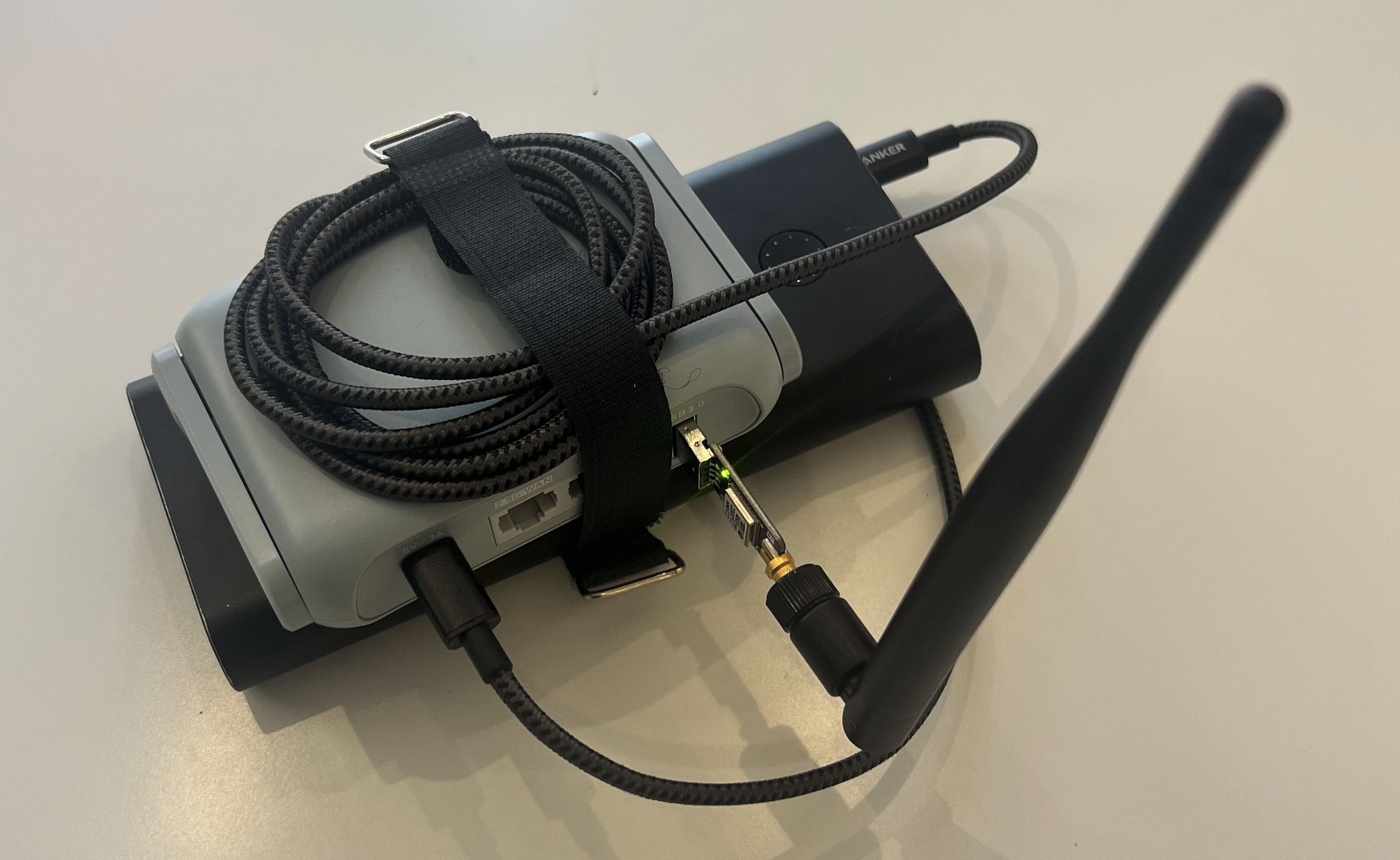
Our portable WiFi HaLow bridge
We constructed a network using two evaluation kits, one placed in our second floor office next to a window that faces down a street, and the other velcroed to a powerbank allowing it to be easier moved down the street for measurements to be taken of signal strength and negotiated link speed between the two stations.
Test traffic would be generated over the link with an mobile device connecting to the mobile station, via conventional WiFi, which would use the WiFi HaLow bridge to communicate with a Butter Box back in the office. Another mobile device was connected to the office station via conventional WiFi so that the two devices could exchange end-to-end encrypted messages using the Delta Chat relay hosted on the Butter Box.
In order to determine the theoretical performance before conducting practical experiments, we did model the expected received signal strength around the office station:
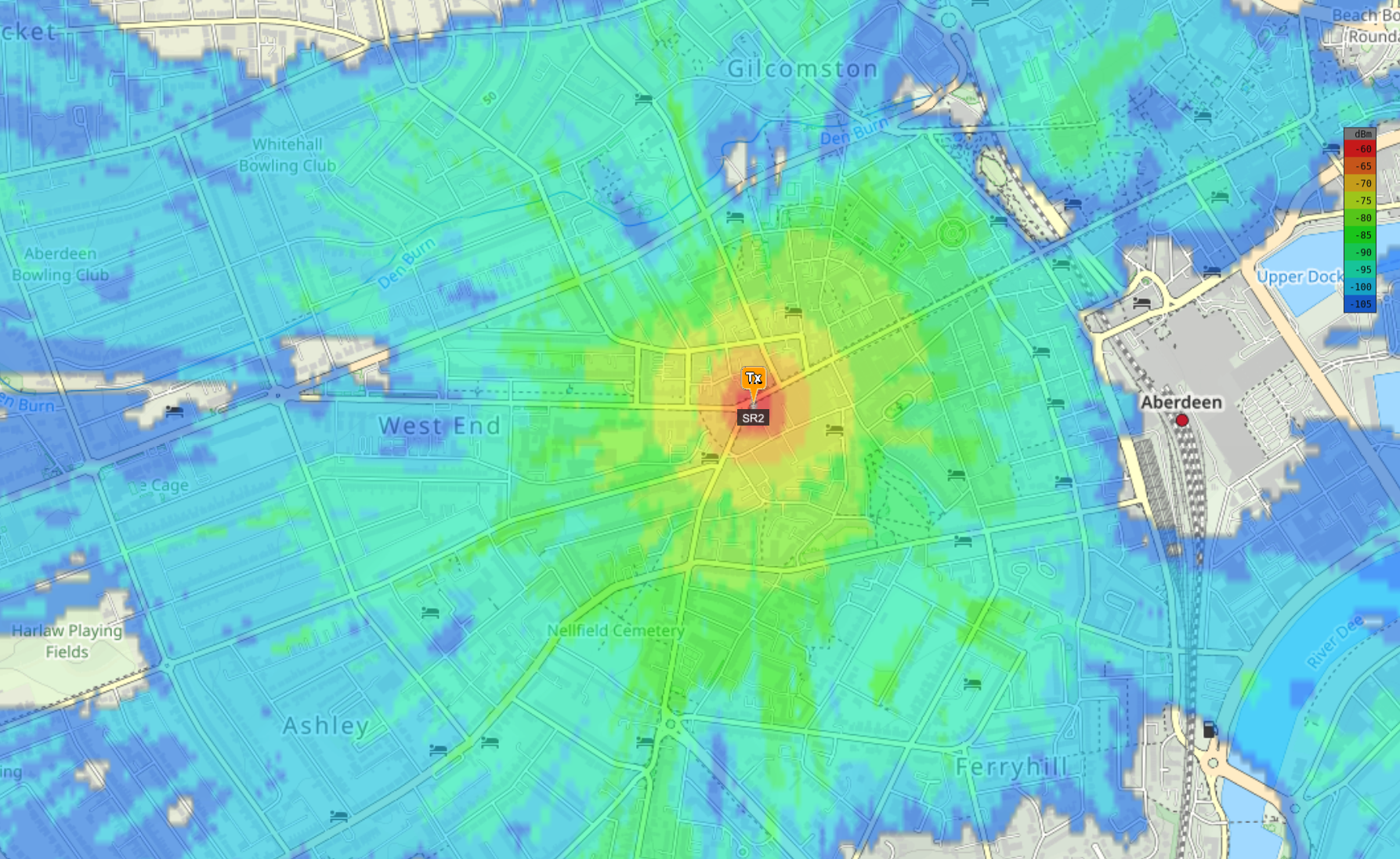
Coverage map for the test WiFi HaLow access point at the SR2 office
The colours in this diagram change as signal strength decreases moving away from the office, from red through yellow, green, and blue. From the data sheet, we know the expected link speed achievable for each level of received signal strength:
| 1 MHz Channel | 2 MHz Channel | ||
|---|---|---|---|
| 0.1 Mbps | -107 dBm | — | |
| 0.3 Mbps | -106 dBm | 0.7 Mbps | -103 dBm |
| 0.7 Mbps | -104 dBm | 1.4 Mbps | -101 dBm |
| 1.0 Mbps | -102 dBm | 2.2 Mbps | -99 dBm |
| 1.3 Mbps | -99 dBm | 2.9 Mbps | -96 dBm |
| 2.0 Mbps | -96 dBm | 4.3 Mbps | -93 dBm |
| 2.7 Mbps | -92 dBm | 5.8 Mbps | -89 dBm |
| 3.0 Mbps | -90 dBm | 6.5 Mbps | -87 dBm |
| 3.3 Mbps | -89 dBm | 7.2 Mbps | -86 dBm |
| 4.0 Mbps | -85 dBm | 8.9 Mbps | -82 dBm |
| 4.4 Mbps | -83 dBm | — | |
Our test path was to the left of the office on the map above, towards “West End”. We expected reliable connectivity at a speed >2 Mbps up until we were approaching the threshold where we expected to drop below 96 dBm, where the greens start to turn into blues approximately 500 meters from the office. What we found, however, was that the negotiated link speed of the bridge was volatile even just 50 meters down the road. We would frequently see the link speeds drop to 0.3 Mbps before recovering tens of seconds later. This is obviously not the ideal environment being an urban environment with vehicular traffic and plenty of other devices competing for spectrum. (Check out the Morse Micro YouTube channel if you want to see some ideal environment tests, like this one achieving 3km range along Ocean Beach, California).
At 500 meters it was still possible, albeit frustratingly slow at times, to access the Butter Box interface over the bridge. At that distance, it would be practical to have a second Butter Box to provide an interface and Delta Chat relay, and then allow the relays to communicate over the bridge but keep other interactions local. Delta Chat is built on email which was designed to be delay tolerant from the start and so is well suited for this use case.
WiFi HaLow operates in an ISM (industrial, scientific, and medical) band. This is a special allocation where the device is certified but the individual operator does not need a licence themselves, as they would with marine, air, or land mobile radio equipment. Part of this certification is that the equipment must cooperate with other spectrum users and this is implemented in WiFi HaLow, as with conventional WiFi, with a “listen before send” test. If another device is sending data then the device must wait for the channel to be clear until it is able to transmit.
Unfortunately due to weather we did not have many opportunities to field test the equipment, so do not have comparable data for less dense environments or environments with lower vehicular traffic. One of the things we note is very common on the 868MHz band, at least in the UK, is vehicle tyre pressure sensors that are communicating from the spinning tyre back to the car to alert drivers to low pressure.
LoRa
LoRa (from “long range”) is a physical layer radio modulation technique based on chirp spread spectrum. It encodes data by sweeping radio signals across frequencies making the signal resistant to interference and capable of travelling greater distances at lower power.
LoRa itself is not a complete network stack and only provides the physical radio characteristics. It is not possible to build a fully open source LoRa system as its physical layer is a proprietary standard owned by Semtech. The techniques that make LoRa function are locked behind semiconductor licensing.
Like WiFi HaLow, it uses the 868MHz/915MHz bands, but also has the option of a second band at 433MHz. While you’re more likely to get a range gain from using a better antenna or feeder than from shifting from the 868MHz to 433MHz band, the ISM band at 433MHz overlaps with the 70cm amateur radio band in regions 1 and 2, and some region 3 countries. This overlap has led to the production of hardware with transmit power capability than would be allowed when operating as an ISM device, and this higher power often produces very impressive range results.
The tradeoff here is more extreme, but it is the same as for WiFi HaLow, you sacrifice throughput for range. For our testing we used a pair of RS232 to LoRa bridges purchased from AliExpress. These are available for just £25.91 ex. VAT each at time of writing, considerably cheaper than the WiFi HaLow kit. They were labelled as “USR-LG206-P” and while we were unable to obtain a datasheet, the listing stated that we would get 2680 bits per second. Not megabits, not kilobits, just bits.
We confirmed that data could indeed be sent over greater distances than WiFi HaLow in our initial testing however this throughput was not suitable to attempt to load the Butter Box portal. One possibility for future exploration would be to run UUCP over the emulated serial link. The necessary software for this is maintained in Debian to this day and would be ready for configuration in a custom Delta Chat relay configuration.
Projects like tinySSB recognise the severe limitations of LoRa and have adapted their protocols to the lower throughput rate, including enhanced compression, smaller packet sizes, and even ignoring some of the restrictions that are placed on ISM band users like duty cycle restrictions. Butter Box could act as a node in these kinds of mesh networks, but ultimately these systems serve different purposes.
The Verdict
LoRa has superior range and the equipment may be more widely available at a cheaper price, but the throughput is low enough that it requires protocols that have been specifically designed with these slow speeds and high latency in mind. Even transmitting low resolution images over these kinds of links would tie them up for minutes at a time. If you need to get smaller amounts of data over greater distances then it’s definitely a great technology but for the Butter Box it does not compliment any existing functionality.
WiFi HaLow may allow a Butter Box deployment to spread across a school campus, refugee camp, or evacuation centre with less equipment required for a rapid deployment. Updates provided to one Butter Box could make their way through a network of Butter Boxes at reasonable speeds. We believe that in a less dense environment, with fewer devices competing for that radio spectrum, the performance would be more reliable however we were not able to fully explore this. For many deployments though, the current cost of the hardware may be prohibitive. We are hopeful that the price of this will come down as Morse Micro moves from the evaluation kits towards production quality implementations.